Date: about 1700
Maker: cabinetwork attributed to André-Charles Boulle (1642–1732)
Materials: oak, amaranth, ebony, turtleshell, brass, pewter, gilt bronze and steel
Measurements: 255 x 162.7 x 61 cm
Inv. no. F62
Monumental wardrobes such as this made a relatively late appearance in French furniture design, emerging in the 1680s. Probably intended for the safekeeping of documents and objects, these so-called armoires fortes could be secured under lock and key.
Boulle’s early models of these wardrobes (F61), for which a drawing survives, contained panels of wood marquetry with floral motifs, but he later developed them into elaborate displays of première- and contre-partie marquetry and sculptural gilt-bronze mounts.
In a sumptuary declaration of 7 April 1700, Boulle’s workshop was recorded as containing nine such wardrobes, both in première- and contre-partie, suggesting that by this time they accounted for a significant proportion of his production.
Although seemingly a pair with another example in the Wallace Collection (F61), this wardrobe is possibly slightly earlier than its counterpart and has a separate provenance before 1870 (after which they were inventoried as a pair).
It is not known precisely when F62 was acquired by the 4th Marquess of Hertford, but it is likely to have been in England, as he kept the wardrobe in Hertford House.
The doors of the wardrobe are divided into three panels, all in première-partie, unlike F61, on which the top and bottom panels are in contre-partie.
These central panels contain figurative mounts with scenes from Ovid’s Metamorphoses, set under brass marquetry canopies. On the left-hand door is a depiction of Apollo and Daphne.
With leaves and branches sprouting from her head and fingers, Daphne is in the process of transforming into a laurel tree to escape the unwanted advances of the sun god.
On the right-hand door is another scene taken from the Metamorphoses, this time depicting Apollo and Marsyas. The satyr Marsyas had boasted about his skill in playing the Aulos, a double-piped flute, and challenged the god of music to a competition.
After winning the contest, Apollo punished Marsyas for his arrogance, tying him to a tree and skinning him alive.
Boulle is thought to have created these mounts based on drawings by Raphael that were part of his personal collection. These were sadly destroyed in a workshop fire on 30 August 1720. They were listed among the losses as a ‘collection of forty-eight designs by the hand of Raphael, subject of metamorphoses’.
However, an inventory compiled after Boulle’s death in 1732 records a book containing prints of the Metamorphoses by various artists.
Many of Raphael’s designs had been preserved and disseminated through prints made by artists associated with his studio. It is possible that some of these were included in Boulle’s volume and served as an alternative source of inspiration.
Several of the gilt-bronze mounts have been stamped with a crowned ‘C’, a tax mark that indicates the wardrobe was on the market between 1745 and 1749. During these years, taxes were levied on works made of various materials and were stamped accordingly: in this case with ‘C’ for cuivre (copper, a constituent element of brass).
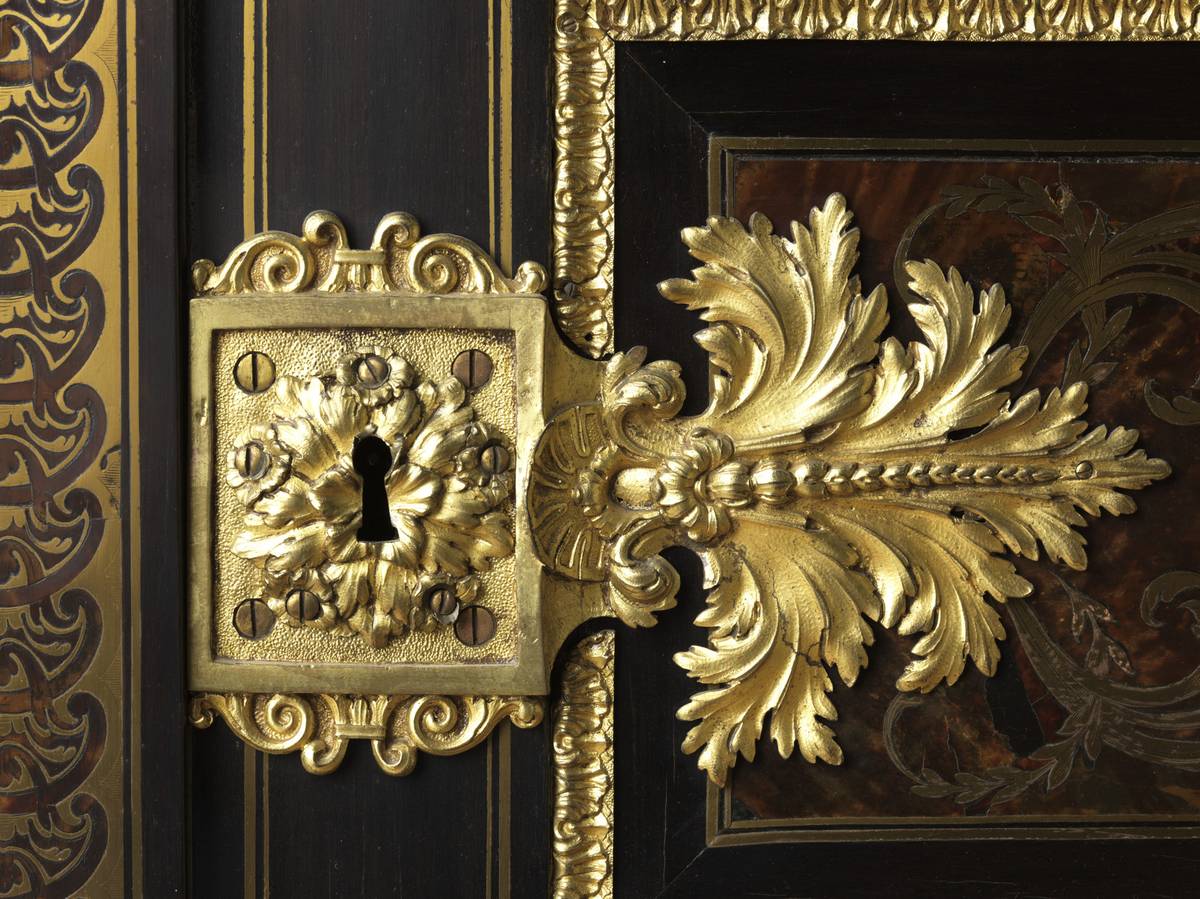
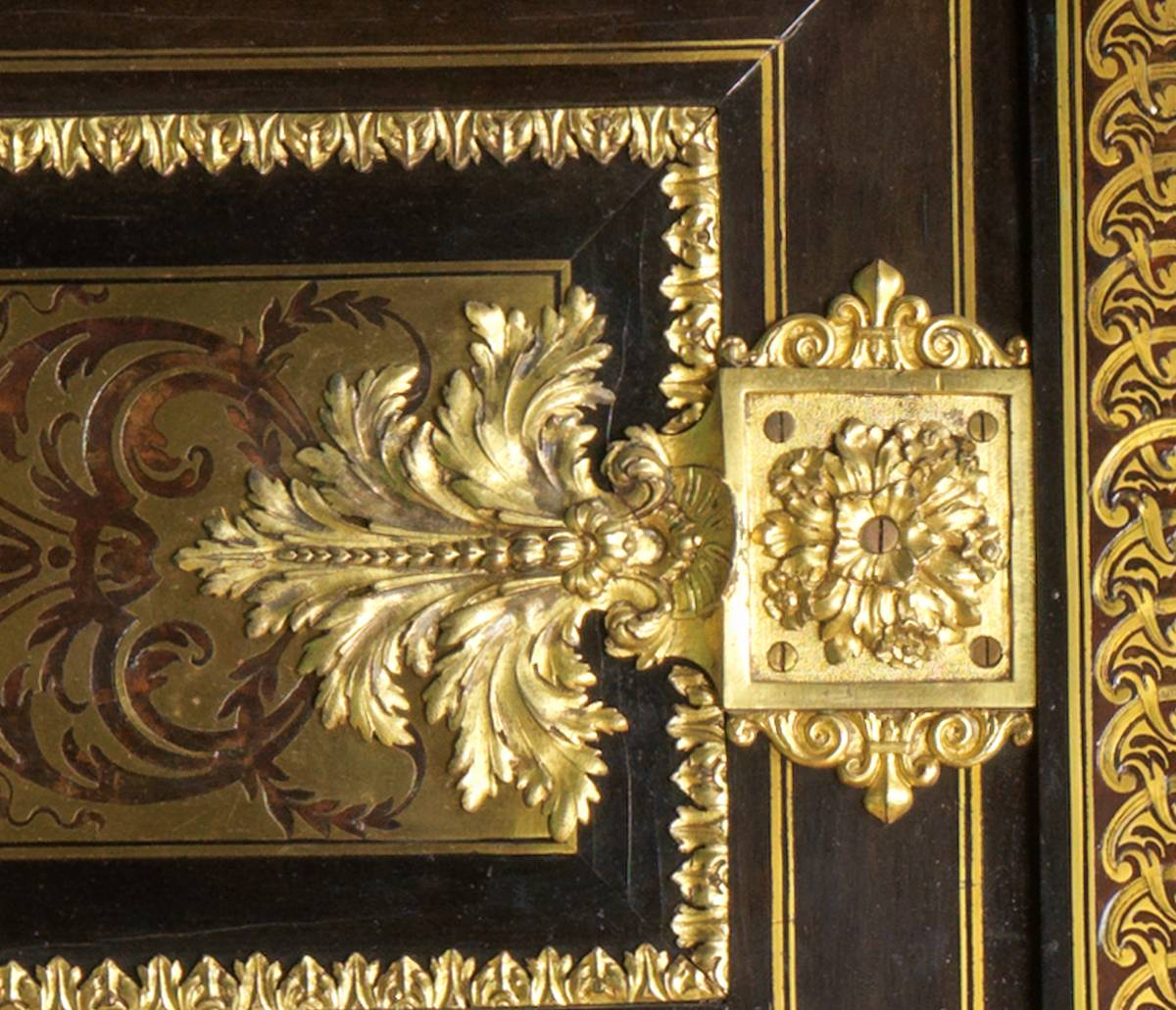
The mounts have also suffered modification. Above and below each of the front hinge plates, the original fleur-de-lys details, which can be seen on F61, have been removed. This was probably carried out during the French Revolution to lessen royal association and make the wardrobe more saleable.
Comparison of F61 and F62 hinges